Hydraulic Controlled Components
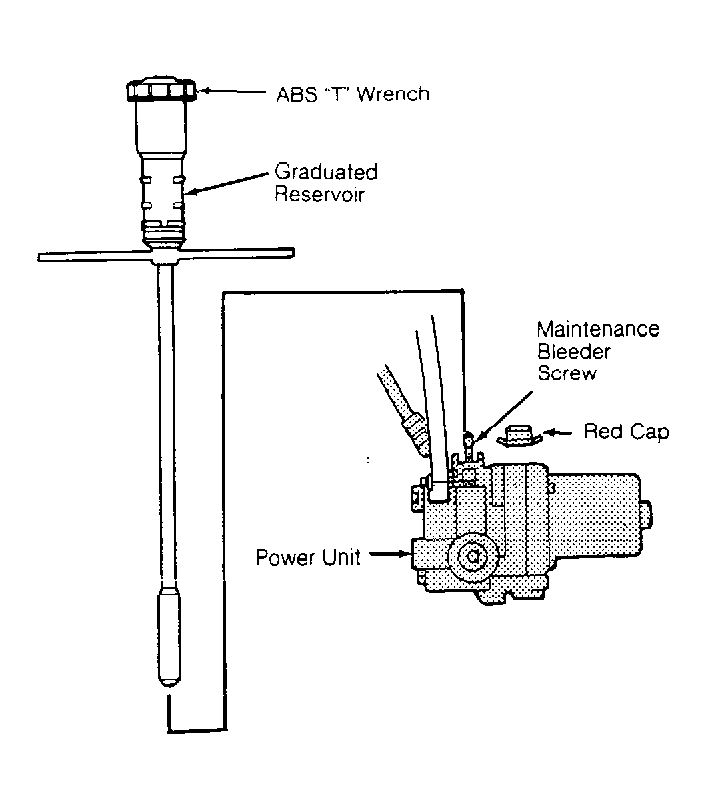
- Check ABS fuses. Ensure brake lines are not kinked or leaking and brake fluid level is okay. Unplug pressure switch connector. Using a DVOM, check for continuity between Black and Yellow wires. If no continuity exists, go to step 2). If continuity exists, use ABS "T" Wrench (07HAA-SG00100) to bleed high-pressure fluid from maintenance bleeder screw. See Fig 1
. Recheck pressure switch for continuity. If continuity exists, replace pressure switch.
- If no continuity exists, reconnect pressure switch connector. Using ABS "T" Wrench (07HAA-SG00100), loosen maintenance bleeder screw to relieve accumulator line pressure. See Fig 1
. Go to next step.
 Courtesy of AMERICAN HONDA MOTOR CO., INC.
- Raise and support vehicle. Start engine and place transmission into gear. With vehicle running at a minimum of 6 MPH, check pump motor operation. If pump motor operates, go to step 6). If pump motor does not operate, disconnect 18-pin connector from control unit. Check for continuity between Yellow wire and ground. If continuity exists, repair Yellow wire between control unit and pressure switch. If no continuity exists, go to next step.
- Using a jumper wire, connect Yellow/Red wire to ground. Turn ignition on. If pump motor runs, replace faulty control unit. If pump motor does not run, remove pump motor relay and test. See RELAY TEST in this article. Replace relay if defective. If pump motor relay is okay, use a jumper wire to connect White/Red and White/Blue wires together.
- If pump motor does not run, go to step 9). If pump motor runs, check for battery voltage between Black/Yellow wire and ground. If battery voltage is not present, repair Black/Yellow wire between fuse No. 17 and pump motor relay. If battery voltage is present, repair Yellow/Red wire between control unit and pump motor relay.
- If pump motor operated in step 3), check if pump motor operates with an increasingly loud, raspy noise. If the noise is not present, bleed system. See AIR BLEEDING
under BLEEDING SYSTEM in this article. If noise exists, motor should stop after 60 seconds. If motor stops after 60 seconds, go to next step. If motor stops after 2 minutes, replace pressure switch.
- Ensure fluid level in reservoir drops and contains no air. Allow fluid to stabilize before checking. If fluid level responds correctly, system is okay. Recheck pump motor to ensure problem is not intermittent. If fluid level remains unchanged and air bubbles are present in reservoir tank, go to next step.
- Using ABS "T" wrench, check fluid quantity by bleeding accumulator line pressure. See Fig 1
. If fluid quantity in graduated reservoir is more than 160 cc, replace accumulator. If fluid quantity is less than 120 cc, check for modulator inlet solenoid leak or accumulator leak. If fluid level rises, replace modulator.
- Using a DVOM, check for battery voltage between White/Red wire and ground. If battery voltage is present, go to next step. If battery voltage is not present, repair open in White/Red wire between fuse and pump motor relay.
- Check for battery voltage between pump motor White/Blue wire and ground. If battery voltage is present, replace faulty pump motor. If battery voltage is not present, repair White/Blue wire between motor relay and pump motor or open in Black wire between pump motor and ground. Check for poor ground connection.