Retrieving Codes
NOTE:
Ensure battery voltage is proper before retrieving codes.
- Turn ignition switch to "OFF" position. Connect either a voltmeter between MPI diagnostic terminal and Ground terminal of diagnostic connector, or multi-use tester (scan tool) to diagnostic connector and cigarette lighter. See Fig 1
. Turn ignition switch to "ON" position and disclosure of ECU memory (fault codes) will begin.
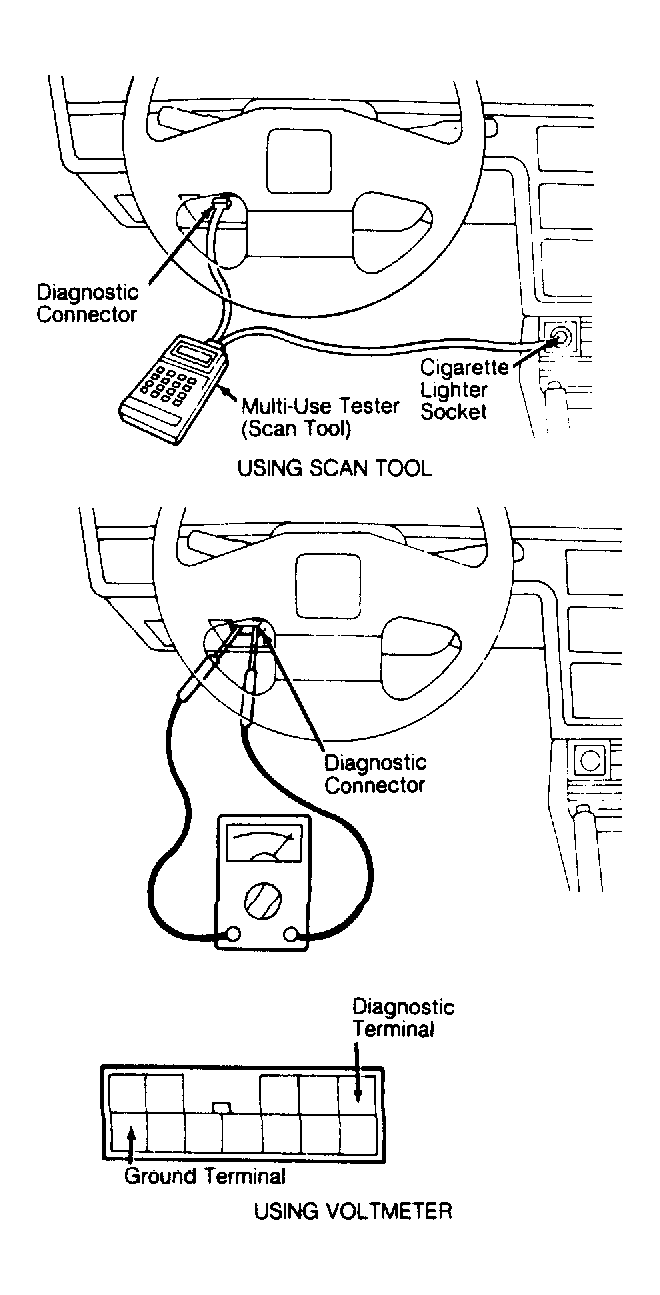 Courtesy of HYUNDAI MOTOR CO.
- If using voltmeter to retrieve fault codes, it is important that voltage signals are accurately timed. Signals will appear in long and short pulses. Long pulses represent a numeral 10, whereas short pulses represent a numeral one. An example of fault code 15 would be one long pulse along with 5 short pulses.
DIAGNOSTIC CODE
| Code Number |
Fault Item |
Probable Cause |
| 11 |
O2 Sensor |
Fuel Pres., Injectors, Vacuum Leak, O2 Sensor |
| 12 |
Airflow Sensor |
Airflow Sensor |
| 13 |
Intake Air Temp Sensor |
Intake Air Temp Sensor |
| 14 |
Throttle Pos Sensor |
Throttle Position Sensor, Idle Switch |
| 15 |
Motor Position Sensor |
Motor Position Sensor |
| 21 |
Coolant Temp Sensor |
Coolant Temperature Sensor |
| 22 |
Crank Angle Sensor |
Crank Angle Sensor |
| 23 |
TDC Sensor (No. 1 Cyl) |
Distributor |
| 24 |
Speed Sensor Reed Swtch |
Vehicle Speed Sensor Reed Switch |
| 25 |
Barometric Pressure Sensor |
Barometric Pressure Sensor |
| 41 |
Fuel Injector |
Injector Coil Resistance |
| 42 |
Fuel Pump |
Control Relay |
| 43 |
EGR Temp Sensor (Ca. Only) |
EGR Temp. Sensor, Vlv., Ctrl. Sol., Ctrl. Vac. |