Starter System Test
- Check Operation
Ensure battery is fully charged and in good condition. Ensure battery cables and connections are in good condition. Turn ignition switch to Start position. If engine cranks slowly, go to VOLTAGE DROP TEST. If engine does not crank, go to next step.
- Check For Start Signal To Solenoid
Disconnect starter solenoid "S" terminal. See Figure
. While holding ignition switch in Start position, measure voltage between "S" terminal (harness side) and ground. If battery voltage does not exist, go to next step. If battery voltage exists, go to SOLENOID TEST under BENCH TESTING. If solenoid is okay, replace starter motor.
- Bypass Start Circuit
Connect one lead of remote starter switch to starter solenoid battery cable terminal. Connect other lead to "S" terminal on starter solenoid. Operate remote starter switch. If engine cranks normally, go to next step. If engine does not crank, repair or replace starter. If engine cranks sluggishly, recheck battery, engine ground and starter cables and connections. Repair or replace starter if battery, cables and connections are good.
- Check TR Sensor
Check TR sensor, see TRANSMISSION RANGE (TR) SENSOR TEST
. Replace TR sensor if necessary. If TR sensor is okay, go to next step.
- Check Voltage To TR Sensor
Turn ignition on. Measure voltage between ground and TR sensor harness connector terminal No. 4 (Light Green wire). See Figure
. If battery voltage exists, restore electrical connections and go to next step. If battery voltage does not exist, repair open Light Green wire between fuse panel and TR sensor harness connector. Restore electrical connections and check system operation.
- Check Power To Inhibit Relay
Turn ignition off. Ensure transmission is in Park. Remove inhibit relay located in left front engine compartment relay block. Turn ignition on. Measure voltage between ground and inhibit relay harness connector terminals No. 1 and 5. See Fig 1
. If battery voltage exists at both terminals, go to next step. If battery voltage does not exist at both terminals, repair open wire in question. See WIRING DIAGRAMS.
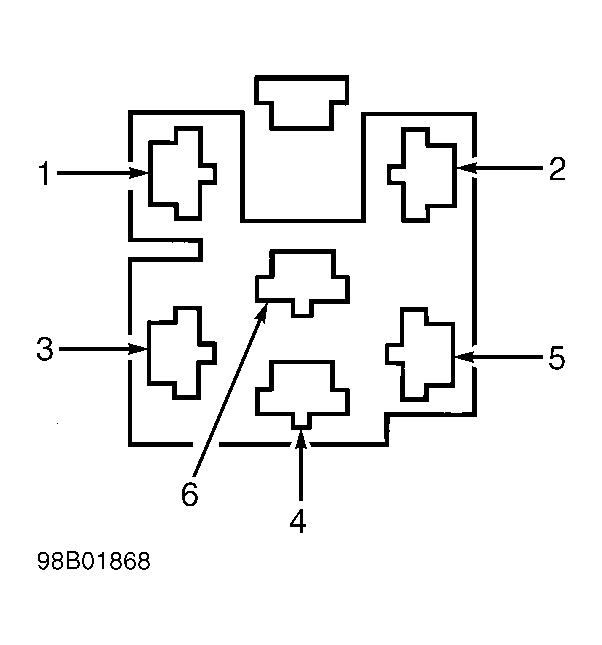 Courtesy of FORD MOTOR CO.
- Check Relay Ground Circuit
Measure resistance of Black wire between ground and inhibit relay terminal No. 2. If resistance is less than 5 ohms, go to next step. If resistance is greater than 5 ohms, repair open ground wire (Black). Ground point is located at left front of engine compartment. Restore electrical connections and check system operation.
- Check Red/White Wire
Measure resistance of Red/White wire between inhibit relay terminal No. 5 and starter motor harness connector. If resistance is greater than 5 ohms, repair open Red/White wire between inhibit relay and starter motor. If resistance is less than 5 ohms on models without anti-theft system, replace inhibit relay. Restore electrical connections and check system operation. On models equipped with anti-theft system, problem may be in anti-theft system. See ANTI-THEFT SYSTEM - ACTIVE
article in ACCESSORIES & EQUIPMENT for testing procedure.