PEUGEOT Engine Modification: Operation
- When starting, transistor in control box turns on electro valve, closing valve to carburetor which subjects vacuum unit to atmospheric pressure. In this condition device has no influence on engine.
- When vehicle reaches a speed of 22 MPH (304), 25 MPH (504) sensing head turns off transistor in control box. This closes electro valve opening to atmospheric air. Unit is now subjected to engine vacuum. Vacuum diaphragm pulls on rod, activating lever on carburetor until it abuts on adjuster screw.
- When accelerator pedal is released, throttle closes, reverting system to fast idle position. Under these conditions, when throttle is slightly open, manifold vacuum is reduced eliminating too rich a mixture.
- When vehicle slows to 19 MPH (304), 22 MPH (504) sensing head turns on transistor in control box, this reopens electro valve, which opens valve to atmospheric pressure. This returns vacuum diaphragm to a resting position. Throttle butterfly closes to normal idling position (800 RPM).
- On both 304 and 504, air flap is controlled by a wax thermostat. When intake air is cold, the element contracts and holds flap closed, cutting off cold air and opening hot air intake. When element becomes heated, it expands and closes hot air intake, opening cold air duct. In use, flap provides a way for mixing heated air and underhood air to provide an even intake air temperature even at low ambient temperatures.
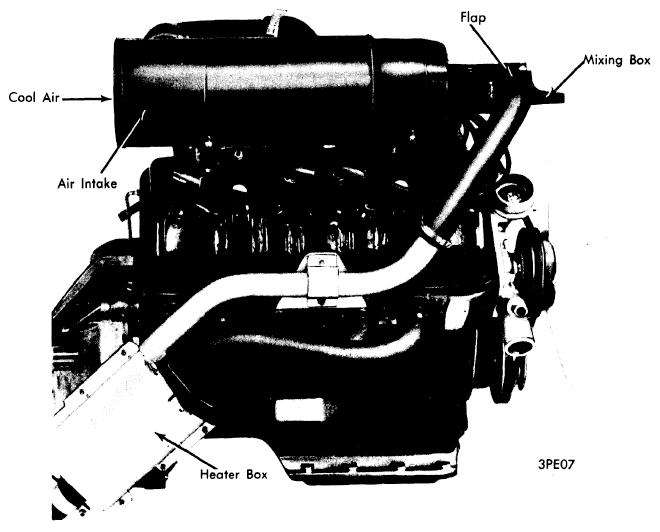 Courtesy of PEUGEOT MOTORS OF AMERICA, INC.
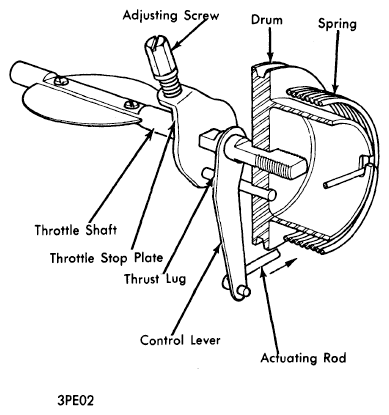 Courtesy of PEUGEOT MOTORS OF AMERICA, INC.