No Start
- Determine if fault is fuel or ignition. Check fuel pressure. See FUEL PRESSURE under FUEL SYSTEM. If fuel pressure is not as specified, repair fuel system as necessary. If fuel pressure is as specified, fuel system is okay. Go to next step.
- Using a high output spark tester, check for spark at end of one spark plug wire. If spark is not present, go to next step. If spark is present, remove and inspect all spark plugs. Replace spark plugs as necessary. Try to start engine. If engine starts, fault was due to spark plugs. If engine does not start, check for defective mass airflow sensor or engine coolant temperature sensor. See appropriate SENSOR RANGE CHARTS
article.
- Disconnect RPM sensor connector. Measure resistance between sensor connector terminals. If resistance is 200-500 ohms, RPM sensor is okay. Go to next step. If resistance is not 200-500 ohms, replace RPM sensor.
- Turn ignition off. Install Breakout Box (981-3190) to ECM. See Fig 2
. Turn ignition on. Set DVOM scale to measure frequency. Connect a DVOM between terminals A21 and A42. Observe DVOM and operate starter motor. If frequency is 1.5-2.0 Hz, go to next step. If frequency is not 1.5-2.0 Hz, a fault exists in Camshaft Position (CMP) sensor circuit. Repair circuit or replace defective CMP sensor and retest.
- Turn ignition off. Disconnect ignition coil 4-pin connector. Measure voltage between ground and terminal No. 3 of ignition coil connector. See Fig 1
. If battery voltage is present, go to next step. If battery voltage is not present, check No. 4 fuse. Replace fuse as necessary. If fuse is okay, locate and repair open in wire between terminal No. 3 of ignition coil connector and fuse No. 4.
- Turn ignition off. Wait about 3 minutes. Measure resistance between ground and terminal No. 1 of ignition coil connector. See Fig 1
. If resistance is zero ohms, go to step 8). If resistance is not zero ohms, go to next step.
- Turn ignition off. Disconnect and inspect ignition coil 4-pin connector. Clean or repair connector as necessary. Measure resistance between ground and terminal No. 1 of coil connector. See Fig 1
. If resistance is zero ohms, cleaning ignition coil connector corrected fault. If resistance is not zero ohms, locate and repair open in terminal No. 1 wire.
- Turn ignition on. Set DVOM to measure frequency. Measure frequency between ground and terminal No. 4 of ignition coil connector while operating starter motor. See Fig 1
. If frequency is 8-10 Hz, circuit is okay. Go to step 11). If frequency is not 8-10 Hz, go to next step.
- Turn ignition on. Measure voltage between ground and terminal No. 4 of ignition coil connector. If voltage is 0-1 volt, go to next step. If voltage is not 0-1 volt, check wire between terminal No. 4 of coil connector and terminal B11 of ECM connector for short to voltage. Repair as necessary.
- Turn ignition off. Wait about 3 minutes. Disconnect ECM connector. Measure resistance between ground and terminal No. 4 of ignition coil connector. See Fig 1
. If resistance is infinite, check for intermittent open in wire between terminal No. 4 of coil connector and terminal B11 of ECM connector. If resistance is not infinite, check for short to ground in wire between terminal No. 4 of coil connector and terminal B11 of ECM connector.
- Turn ignition off. Connect ignition coil connector. Turn ignition on. Disconnect coil wire from distributor cap. Hold end of coil wire about 3-5 mm from ground. Operate starter and check for spark. If spark is present, go to next step. If spark is not present, replace ignition coil and retest.
- Reconnect ignition coil wire. Try to start engine. If engine starts, fault was due to poor connection at ignition coil. If engine does not start, check distributor cap and rotor for cracks, moisture or dirt. Repair as necessary.
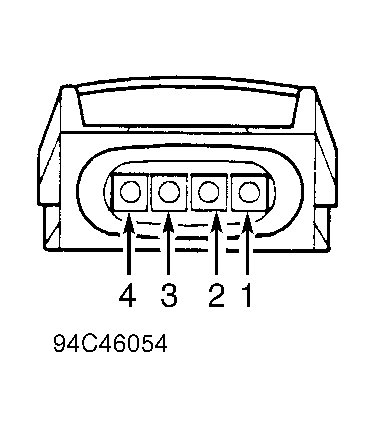 Courtesy of VOLVO CARS OF NORTH AMERICA.
 Courtesy of VOLVO CARS OF NORTH AMERICA.